Panteão Nacional
Santa Engrácia’s endless works finished at last in 1966: Lisbon’s National Pantheon holds the tombs of Amália, Eusébio and the presidents.
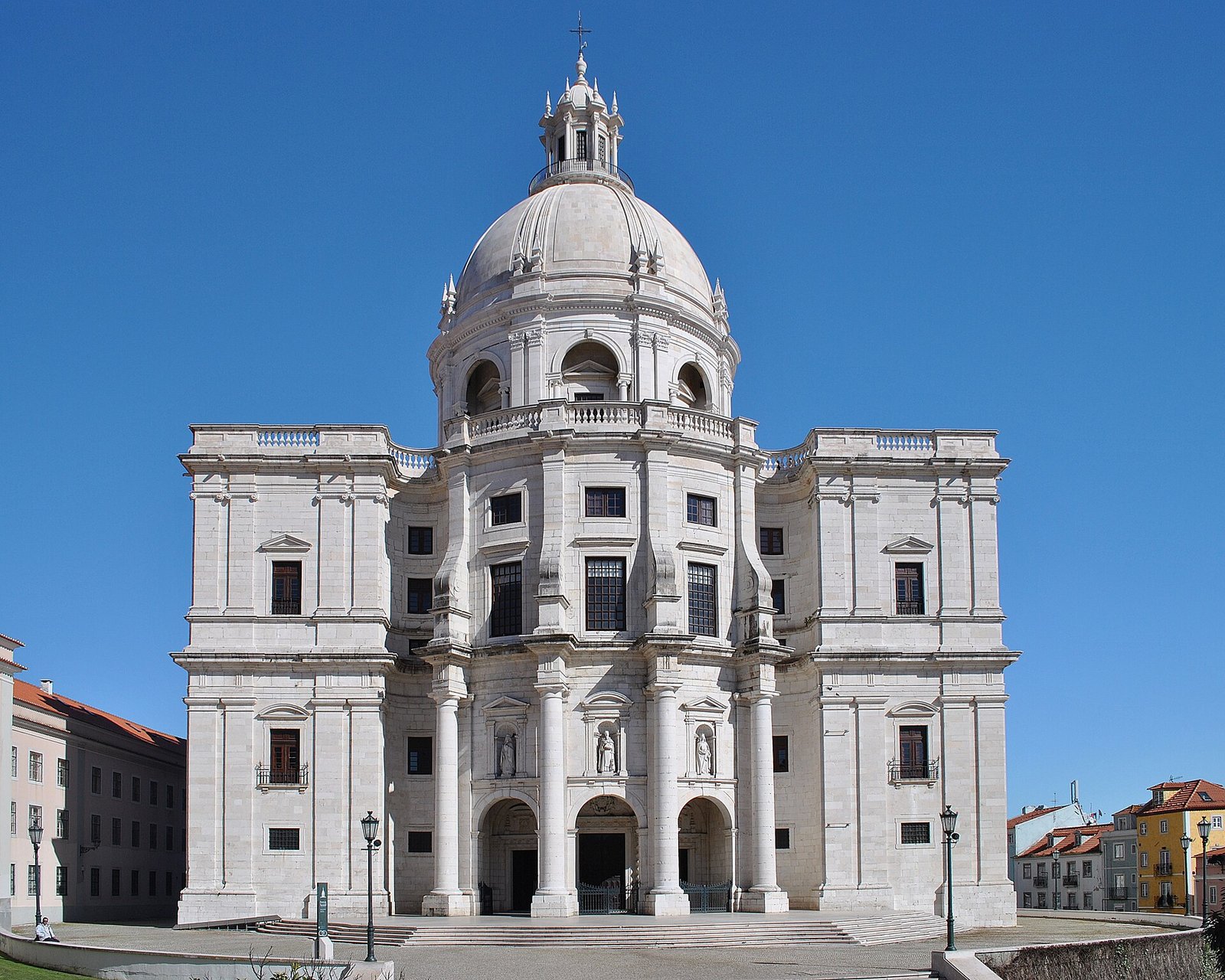
For three and a half centuries, the church of Santa Engrácia was Lisbon’s most famous unfinished building — so famous that its endless works gave the Portuguese language the phrase “obras de Santa Engrácia” for anything that never seems to end. Completed at last in 1966, the baroque temple became the National Pantheon, where the nation keeps its great dead.
Three hundred years of building
Begun in the 16th century, rebuilt in the 17th by the architect João Antunes, closed to worship while still roofless and used in the 20th century as a military boot factory, the church was finally finished in 1966 and inaugurated as the National Pantheon. Under its vast dome — one of the great baroque interiors of Europe, dressed in coloured marble — stand the cenotaphs of Camões, Vasco da Gama, Pedro Álvares Cabral and Prince Henry the Navigator, while the tomb chambers hold presidents of the republic, the writer Sophia de Mello Breyner, the fado singer Amália Rodrigues, the footballer Eusébio, and, since 2025, the novelist Eça de Queiroz. The terrace, forty metres up, opens one of the finest views of the river and the old city; just below stand the monastery of São Vicente de Fora (see the São Vicente de Fora page) and the Castle of São Jorge, the hilltop crown of Lisbon.
What to see
- The dome, seen from the central nave
- The cenotaphs of the navigators and poets
- The tomb chambers of presidents and artists
- The roof terrace over Alfama and the Tagus
- The interpretive centre on the building’s history
Practical information
The Pantheon stands at Campo de Santa Clara, in the old quarter of Santa Clara, a short walk from the flea market and from Santa Apolónia station. It is closed on Mondays; hours are shorter in winter.
Image credit: Panteão Nacional by Eurico Zimbres — CC BY-SA 3.0, via Wikimedia Commons.
Atrakcje
Explore related experiences

 English (UK)
 Português
 Polski
 Nederlands
 Italiano
 Français
 Español
 Deutsch
 한국어
한국어 简体中文
简体中文 Svenska