Boca do Inferno
A collapsed sea cave on the cliffs of Cascais, where the Atlantic breaks inside a chasm under the Guincho road.
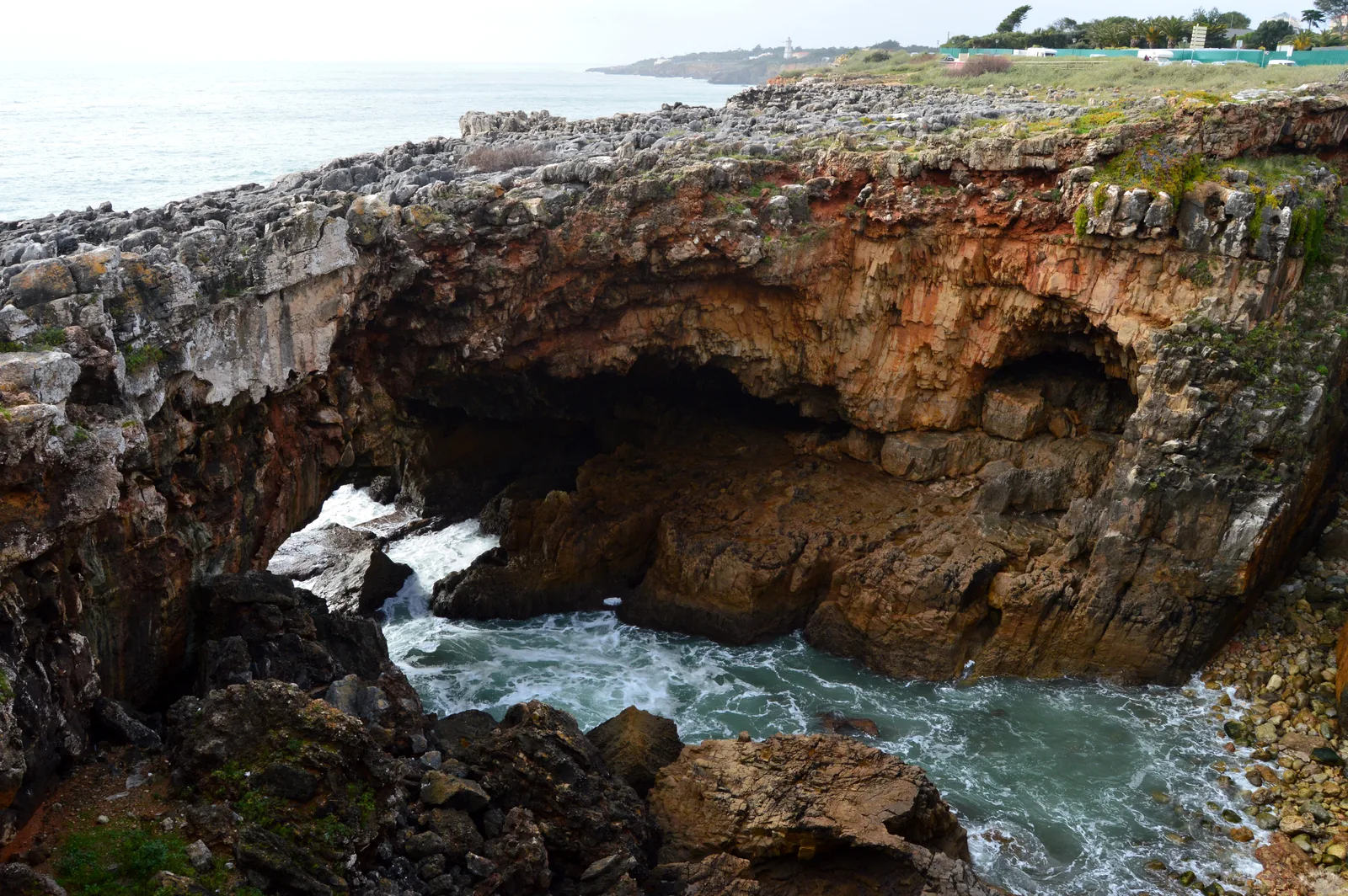
At the western end of the bay of Cascais, the cliff opens into a chasm the old fishermen called the mouth of hell: a collapsed sea cave where the Atlantic enters the rock and explodes against the inner walls. The Boca do Inferno is a work of the sea in progress, and the cliff line between the bay and Guincho keeps breaking a little further every winter.
A cliff that the sea is still eating
The cavity formed where a softer band of limestone met the waves, and the roof fell in, leaving a window to the ocean and a cavern that roars when the swell runs. In calm weather the water below turns clear green and the cave reads as a quiet quarry; in westerly storms the spray rises over the viewpoint and the road closes. The literature of the nineteenth century found it picturesque, and the painters of Cascais came here to work.
Between the marina and Guincho
The cliff walk from the marina of Cascais reaches the viewpoint in a few minutes, and the road continues west to the dunes of the Cresmina and the beach of Guincho, inside the Sintra-Cascais natural park. The fishermen of the ledges below are part of the scene, and the little fortress of the Guia above keeps the old military road.
What to see
- The chasm and the sea cave under the viewpoint
- The Atlantic breaking into the rock in a westerly swell
- The cliff walk from the marina of Cascais
- The road west to the Cresmina dunes and Guincho
- The fort of the Guia above the cliffs
Practical information
The Boca do Inferno stands on the cliffs west of Cascais, a twenty-minute walk from the town centre or a short drive towards Guincho. Keep behind the safety barriers at all times, especially with a running swell, and check the official websites before visiting.
Image credit: Boca do Inferno by Beatriznog10 — CC BY-SA 3.0, via Wikimedia Commons.
Experiences
Explore related experiences


 English (UK)
 Português
 Polski
 Nederlands
 Italiano
 Français
 Español
 Deutsch
 한국어
 简体中文
 Svenska