Água de Pau
One of São Miguel’s oldest towns, made a vila in 1515, between the volcanic massif of Lagoa do Fogo and the bathing coast of Caloura.

On the green south coast of São Miguel, between Lagoa and Vila Franca do Campo, Água de Pau climbs a hillside where springs run down towards the sea. It was one of the first places the settlers of the island chose for its water and fertile land, and a royal charter made it a town as early as 1515.
One of the island’s first towns
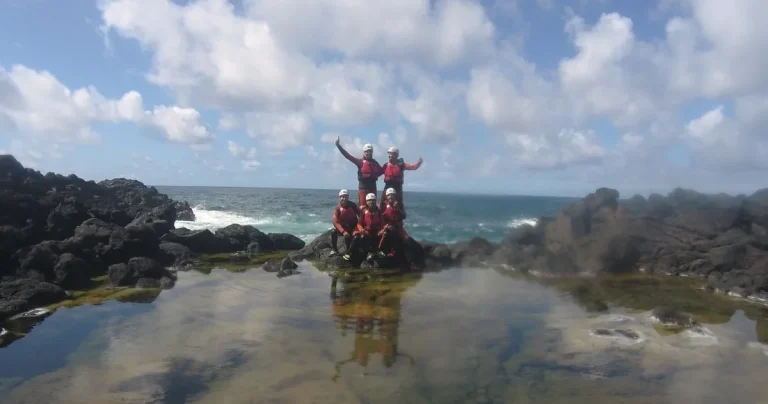
The first colonists moving west from Povoação found here the stream, the shelter and the fields they were looking for, and the church of Nossa Senhora dos Anjos was standing by the middle of the fifteenth century. In 1515 King Manuel I raised Água de Pau to the rank of vila, a title the town kept even after it was absorbed into the neighbouring municipality. Down at the coast, the cove of Caloura served as the town’s landing place and keeps the whitewashed old convent, its chapel dressed in azulejos, above the rocks where swimmers and coasteering groups take to the clear water.
Under the fire mountain
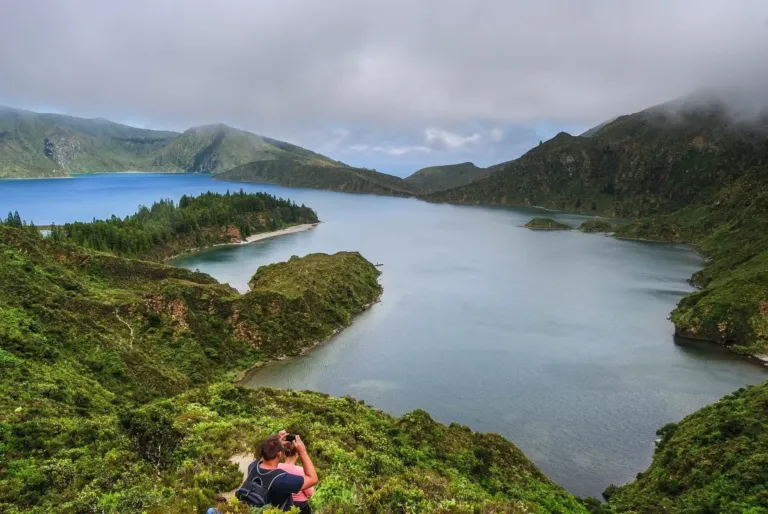
Behind the town rise the heights of the Água de Pau massif, the old volcano at the centre of the island, and in its crater sleeps one of the most beautiful lakes of the archipelago: the Lagoa do Fogo, a protected crater lake ringed with native vegetation. Viewpoints above the town look south over the terraced fields and the São Miguel Island coastline.
What to see
- The church of Nossa Senhora dos Anjos and the old town
- The convent and bathing coast of Caloura
- The viewpoints over the southern coastline
- The Lagoa do Fogo in the massif above the town
Practical information
Água de Pau lies in the municipality of Lagoa, on the southern coast of São Miguel, a few kilometres from the island’s south-coast road. The weather shifts quickly between coast and crater: bring a windproof layer for the massif and shoes with grip for the trails, and check the official websites before setting out.
Image credit: Coastline of São Miguel seen from Caloura 02 by Kritzolina — CC BY-SA 4.0, via Wikimedia Commons.
Experiences
Explore related experiences


 English (UK)
 Português
 Polski
 Nederlands
 Italiano
 Français
 Español
 Deutsch
 한국어
 简体中文
 Svenska