Sé Velha de Coimbra
Portugal’s finest Romanesque cathedral, rising fortress-like above the old city of Coimbra.

Above the old streets of Coimbra, the Sé Velha is the most complete Romanesque cathedral in Portugal. Begun in the twelfth century, when Coimbra was the young kingdom’s capital, it looks more like a fortress than a church — and inside, its austere stone opens onto a rich Gothic cloister and Renaissance art.
History and character
The cathedral was begun in 1162, in the years when Coimbra was the seat of the Portuguese court, and its crenellated walls recall the troubled times of the reconquest. It served as the city’s cathedral until the sixteenth century, when the new cathedral was built; its Renaissance doorway, the Porta Especiosa, belongs to that later golden age.
What to see
- The fortress-like exterior, with its rose window and crenellations.
- The austere Romanesque nave and its gilded retable.
- The Porta Especiosa and the Gothic cloister, with its tombs.
- The Renaissance chapel and the cathedral’s sacred art.
Visiting
The cathedral is in the old upper town of Coimbra, reached on foot from the university quarter. It remains an active place of worship: visits are welcome outside the hours of Mass, and access may be limited during celebrations.
Nearby
The church stands close to the Mosteiro de Santa Cruz and the Jardim da Sereia, with the Mercado Municipal D. Pedro V below in the Baixa. The Biblioteca Joanina, on the hill above, holds the other treasure of Coimbra’s old university.
Information: cm-coimbra.pt.
Image credit: Sé Velha de Coimbra, by Alexkom000, CC BY 4.0, via Wikimedia Commons.
Experiences
Explore related experiences

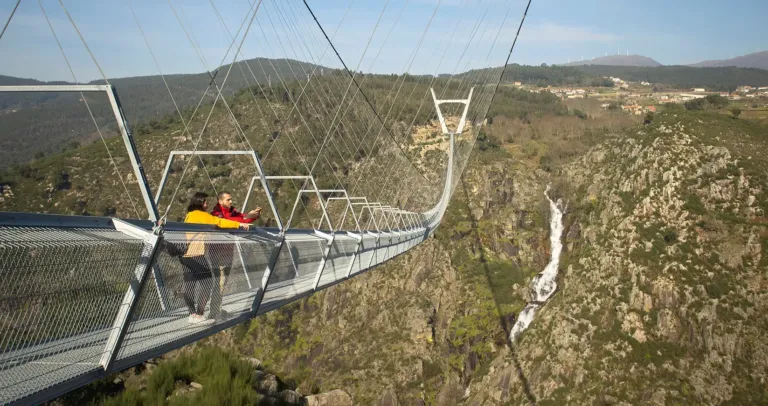
Guided Tour from Porto to the 516 Arouca Bridge & Paiva Walkways
 English (UK)
 Português
 Polski
 Nederlands
 Italiano
 Français
 Español
 Deutsch
 한국어
 简体中文
 Svenska